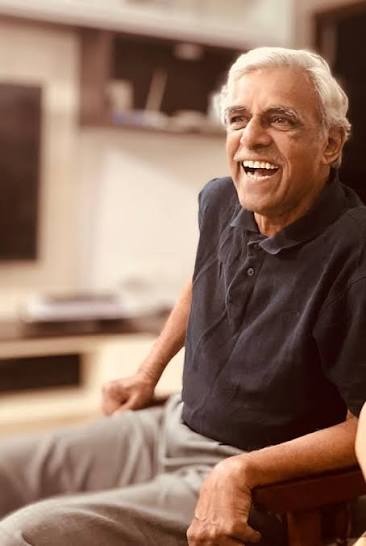
What KV Ganashyam Sir Taught me about Baking

If you grew up in the 90s and 2000s, you would have very likely attended KV Ganashyam sir’s chemistry classes either at National College or his tutorials for your 12th board exams. Attending his classes were a privilege.
Ganashyam sir would explain almost every topic in chemistry with practical examples. He would never limit his classes to what the textbook wanted us to learn. He would always go one step beyond. His classes were always filled with humor. When I became a teacher, I used this technique of taking real world examples to explain concepts from the textbook and of course sprinkle in some humor in class.
Arguably, the most important thing I learned from KV Ganashyam sir is how baking works. Because baking is chemistry. Chemistry is science and everything needs to be accurate. Just like a chemical reaction to occur, you need precision, temperature regulation and exact time for it to be done.
This is a needed value in the kitchen. If you are making a pot of sambar, you need a certain quantity of salt to bring out the flavor of the sambar. Even if you add a pinch of salt lesser than what is needed, the dish is not quite complete. Cooking is a “loose” science. You can get away without measuring ingredients. I don’t think in any desi household you measure how much rice or dal you add to the pot. The whole process is eyeballed.
However, you cannot get away doing this with baking. Baking is an exact science. If the recipe says add 50g of white sugar, you better add 50g of WHITE sugar and not any other variant. You need to be careful with baking because you cannot make changes so easily.
I am talking about this because there are so many “healthy” variants of baked goods these days. For example you have sugar less biscuits, sugarless cakes and even brownies. But how does changing the chemistry of these foods still result in almost no change in how the baked foods taste? Well, because you have not removed something entirely.
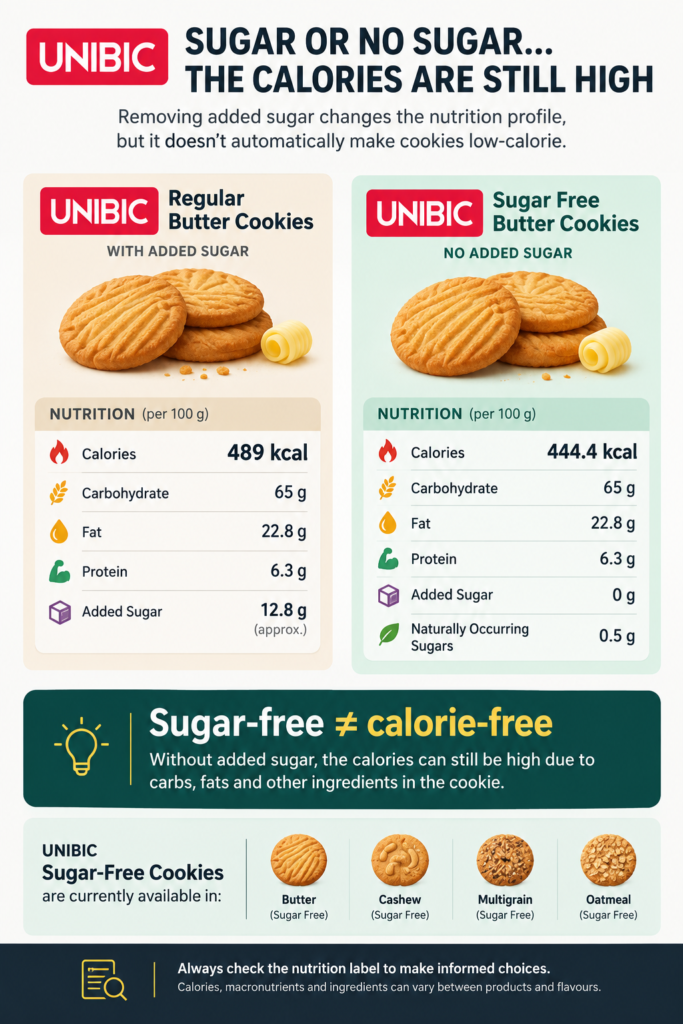
You cannot make zero sugar cookies by keeping the proportions of the rest of the ingredients. If you did that your cookies would come out like cardboard. This is why baking is more scientific than cooking. For cookies to turn out a certain way where they are edible, you need to prepare with a ratio of cooking fats like butter or oils and sugar. Removing or reducing any one of these will change the end result entirely.
Suppose a cookie contains:
- 20 g sugar = 80 kcal
The manufacturer removes the sugar. But now they may need to add:
- Starches
- Maltodextrin (similar to glucose)
- Milk solids
- Fats
to recreate the original texture and mouthfeel.
The result may still be 70–80 kcal, even though the label now says 0 g added sugar or 0 g sugar.
The calories didn’t disappear. They simply came from a different molecule.
This is why chemistry is so important for baking. All brands of baked foods taste nearly identical because baking science gives almost no room to be flexible.
It was heartbreaking to hear that Ganashyam sir is no more. I will never forget his chemistry classes. The knowledge I gained from those sessions are something I use even today to explain to my clients about how food works. Thank for all the infinite knowledge you gave me during chemistry classes. I did not know I could use them for a lifetime.

Kavitha K
Good read 📚
Pooja Jain
Baking is chemistry and your story got me emotional
vipinmksrinath
Thank you so much <3